
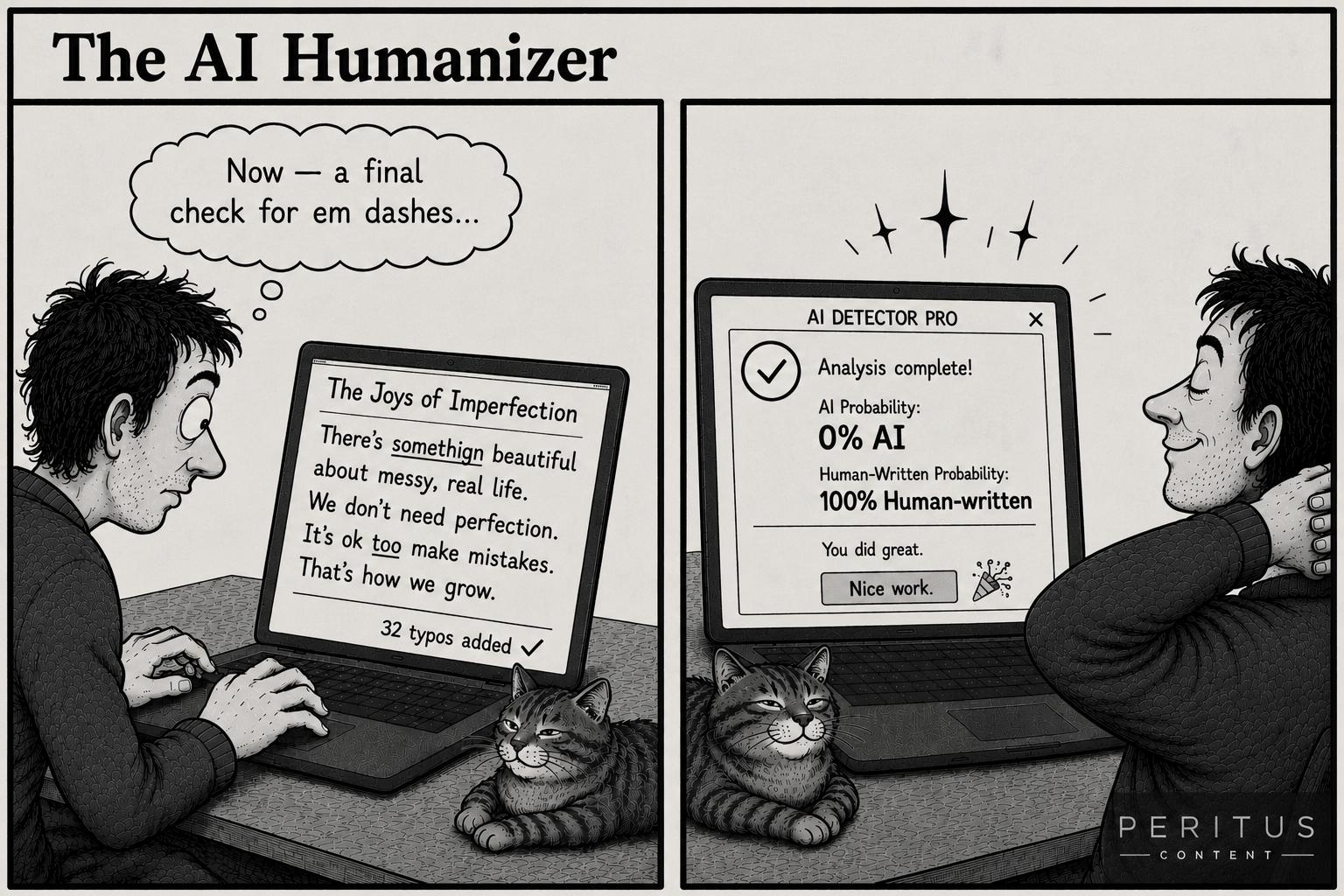
While in real life, “humanizing AI content” didn’t turn out to be as entertaining as John Conner teaching the Terminator to be more human, it may be turning out to be about as successful. If you haven’t seen Terminator 2, spoiler: John wasn’t very successful at all.
In this post, I explore the evidence to determine if humanizing AI content remains worth it in 2026, or if it’s had its heyday.
What Is Humanizing AI Content?
Humanizing AI content is the process of editing AI-generated text so it sounds as if a human wrote it. This typically means editing to make the language more natural, for example, changing “it is” to “it’s” and replacing formal terms and phrases with more conversational language.
Users of large language models (LLMs) like ChatGPT have been humanizing their output since the technology emerged.
Commercial AI humanizing tools and human AI humanizing services arrived hot on the heels of AI detection tools — software that analyses text and determines whether it was AI-generated. Humanizing tools and services promise to make AI content undetectable by these tools, and by extension, more Google.
A Brief History of Humanizing AI-Generated Writing
Here’s how AI humanizing tools and services came about:
- August 2022: Google launches its Helpful Content System to reward content that provides user value, and reduce visibility of low-value content made to rank in search engines.
- December 2022: Google adds an extra “E” for Experience to its EAT framework, making it EEAT: Experience, Expertise, Authoritativeness, and Trustworthiness.
- February 2023: OpenAI releases GPT-4, marking a major step up in the quality of AI output.
- February 2023: Google publishes explicit guidance on AI-generated content and updates EEAT quality standards.
- Late 2023: The first commercial AI humanizer tools hit the market, promising to make AI-produced writing undetectable.
AI Humanizers vs Human-Edited AI Content: Which Does It Best?
The effectiveness of AI humanizer tools varies. Premium AI humanizer tools typically perform better than their free counterparts. Generally speaking, here’s how AI humanizers stack up against human-edited AI content:
| Free AI humanizer tools | Premium AI humanizer tools | Human editing of AI | |
| Ability to pass AI detectors | Inconsistently | In most cases | Dependent on the editor |
| Quality | Rarely | Minimally | May improve quality, but dependent on the editor |
| Speed | Fast | Fast | Slow – may take a few days |
| Cost | Free | From $10 per month | £36–£42/hour according to CIEP 2026 rates |
The Benefits of Humanizing AI Content
Humanizing AI-generated content enables the production of a large amount of text for a comparatively low cost. Large Language Models (LLMs) are inexpensive for now, and some AI humanizing software subscriptions are less than $10 a month.
Those publishing content have two options if they want to avoid it being flagged and penalized for being AI: return to human writers, or stick with AI-generated content and tweak it to pass AI detection.
The Risks of Humanizing AI Content
Humanizing AI-generated content carries several risks:
It Lowers Quality
Humanizing AI content often means lowering its quality. YouTube creator Mateusz Jurga spent over 20 hours testing leading AI humanizer tools and concluded that those that pass AI detectors do so by making the language unusable.
Writer and data scientist David Sweenor has noticed the same. Writing for Medium, he explained how an AI humanizer tool turned his writing into monotonous, robotic-sounding, choppy fragments.
“If you spend enough time reading content online,” he writes, “ you’ll start to spot the mechanical rhythm these tools generate miles away.”
There’s no guarantee that humans are any better at humanizing AI writing. In aiming for the same result as humanizing tools, human editors typically make the same types of changes: making passive structures active, and removing em dashes, semicolons, and formal transitions — often with the use of even more AI.
Humanizing AI Can Be Dangerous
For content that carries a greater risk, humanizing AI-created text can be outright dangerous. Medical content is at the top of this, but legal and financial content are other examples where precise wording is critical.
“Blandification”
Humanized AI-generated content is highly vulnerable to “blandification” — the term given to the homogenization or creeping sameness of creative output that’s made with AI. Humanizing tools can add to this sameness by making the same types of changes across all content. Businesses that rely on AI writing risk losing their identity and blending into the other AI-muffled voices.
Google May Still Penalize It
Google quality raters explicitly assess content for AI, but few have seen the algorithms behind Google’s curtain. This means there’s no guarantee that even a 0% AI detection score will satisfy Google’s quality standards.
What we do know is that Google quality raters rank original content that provides value for visitors highly, and that it explicitly assesses content for AI, which relies on existing data and often fails to go deeper than surface level.
If humanizing doesn’t address issues like low value, lack of expertise, and fluff, Google may still penalize it. In response to a site owner whose AI-generated content plummeted in visibility after Google’s changes, search advocate John Mueller advised:
“I wouldn’t think about it as AI or not, but about the value that the site adds to the web. Just rewriting AI content by a human won’t change that, it won’t make it authentic.”
It Can Extend Delivery Time
The need to humanize AI-generated content adds a step in the content creation process. When the content is humanized, it still needs to be reviewed. This can take longer than reviewing human-written content. For example, if the humanization process changes the meaning of a text, it must be edited to ensure the correct meaning without retriggering AI detection.
It’s not uncommon for businesses to find that the speed advantage that drew them to AI content in the first place has slowed down.
It May Drive Readers Away
AI-generated, human-passing content that doesn’t go beyond surface level is often a dead giveaway to readers. When your target market consists of professionals, same-same surface-level content just doesn’t cut it. If anything, it puts your business in a bad light by suggesting you lack industry expertise.
That’s not to say you should try to pass off AI content as human-written. Although a 2025 study by Schilke & Reimann showed a 16-20 percentage point drop in trust when AI use is disclosed, Brandwatch advocates being upfront about AI use.
Not disclosing AI use and then being exposed for using AI can be incredibly damaging, as Professor Oliver Schilke explains, “If a third party goes in and shares that you used AI, that’s the worst possible outcome as far as trust is concerned.”
The Future Is Human
People have been signalling their preference for human interactions with businesses long before the arrival of generative AI: see if you can find one person who doesn’t hate automated phone systems. Their interaction with businesses’ written content is no different.
According to a YouGov survey, 42% of Britons and 41% of US respondents don’t believe AI provides trustworthy information. Among the Britons, over-55s are most skeptical (51%). But even in the country’s most trusting age group — 25-34 year-olds — almost a third don’t trust AI much or at all.
Working with expert human writers gets you out of the AI-detection, humanization, cat-and-mouse loop and ever-rising costs.
Human-produced writing does best in search. A Semrush study published in April 2026 found 80% of top-spot search results were human-written pages.
Why AI Is No Match For A Human Subject Expert Writer
Human writers have proven effective for centuries — millennia even. Today, AI tools are no match for subject expert human writers, who bring:
- Lived experience and hands-on industry experience that signal expertise and speak directly to readers.
- True understanding of prospective clients’ pain points, helping them to pitch businesses as credible solutions.
- Original thoughts and unique perspectives which make drawing new conclusions and providing insight possible.
As audiences become more aware of the downsides of AI-made content, it becomes harder for them to ignore what it lacks.
Human subject expert writers beat AI hands down for:
- High-impact content that shapes first impressions: landing pages, about pages, company values, etc.
- Content that requires demonstrable expertise.
- Legal content which must keep up with constantly changing rules.
- Content that showcases your products and services.
- Content that requires human sensitivity and lived experience.
Will There Still Be A Place For Humanized AI Content?
There is a place for humanized AI content for the foreseeable future. Humanized AI writing is well-suited to straightforward, structured, often predictable content that doesn’t carry much risk:
- Non-published content like internal communications and newsletters, where reputational and liability stakes are low.
- Non-critical published content such as simple explainers, FAQs, and contact page text.
Humanized AI: The True Cost
While many have been caught in the cycle of AI-generation, humanization, and detection, few have paused to run the numbers and check if the ROI still holds up. We did.
Ahrefs’s 2025 research focuses on AI-generated content for marketing, but its findings translate to other content. It puts the average cost of an AI-generated blog post at $131/£100 and the human-written cost at $611/£450. On first glance, the savings seem great.
But add the cost of humanization. In the UK, that’s around £40 per hour for substantive editing according to CIEP. High-stakes and specialist content may need research to ensure the content is accurate and safe to publish. The hours can easily add up — just 5 hours adds £200 to the bill.
If you trust this type of content to an AI humanizing tool, it’ll still need to be reviewed and possibly further edited by a human.
While this might not completely eliminate the financial benefit of AI content, the humanizing and reviewing burden does reduce it. The back and forth needed to ensure AI content is publication-ready also eats into the speed advantage.
| AI + Humanizing | Subject expert writer | |
| Production cost | $131 / £96 | $388–$650 / £285–£475 |
| Production turnaround time | Instantaneous | 2-5 days |
| Editing cost | $275 / £200 — 5 hrs at $55/£40 per hour | Included |
| Editing turnaround time | 1–2 days + communication time | Included |
| Total Cost | $406 / £298 | $388–$650 / £285–£475 |
| Total Time | 1–2 days + communication time | 2-5 days |
The Most Powerful Way to Use AI
AI is known for its speed and consistency — even to a flaw, as writer Alex Reszelska points out in a May 2026 Guardian article:
“AI has flattened language. Removed the typos, the strange grammar, the gorgeous off rhythm that makes writing feel alive. All of that is disappearing and, with it, we’re losing something profound – the possibility of being moved.”
The most powerful way to use AI is to leverage its strengths by applying AI to more strategic areas of your content workflow. This is also what research suggests audiences want.
After researching the growth of generative AI in the UK, specifically within media, market researcher Ipsos concluded:
“The emerging rule is clear: GenAI is welcome when it helps behind the scenes; it is resisted when it replaces human creativity, voice or editorial judgement.”
AI has the greatest potential when it’s used to support and enhance human work — not replace it. This is how we work at Peritus.
Unless a client specifies otherwise, we only use AI for the following:
- Keyword research: AI is faster and as effective as tools like Ahrefs, Semrush, and Google Keyword Planner.
- Content planning: AI is an excellent content planning assistant and can map out a draft content calendar in a fraction of the time that any human can.
- Content structuring: When given the right input, AI excels at structuring briefs for flow and search performance.
- Assisting with research: AI can source information, but can still be prone to hallucinations, so human verification is non-negotiable.
Transparency regarding AI use is essential. According to Brandwatch, consumers are pro-honesty, not anti-AI. But simply stating that you use AI isn’t the way to go. They advise explaining how you use AI to build confidence with your target audience: “Saying: ‘AI helped, but our team refined it’ is far more credible than vague honesty attempts.”
If you’re looking for a way to improve your content, book a discovery call to find out how Peritus can help.
If you enjoyed reading, please share this post with your network.
Share this post